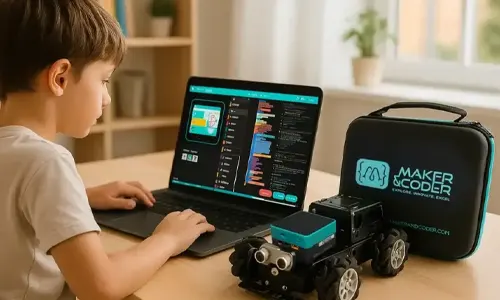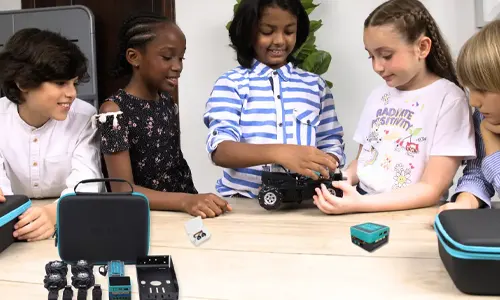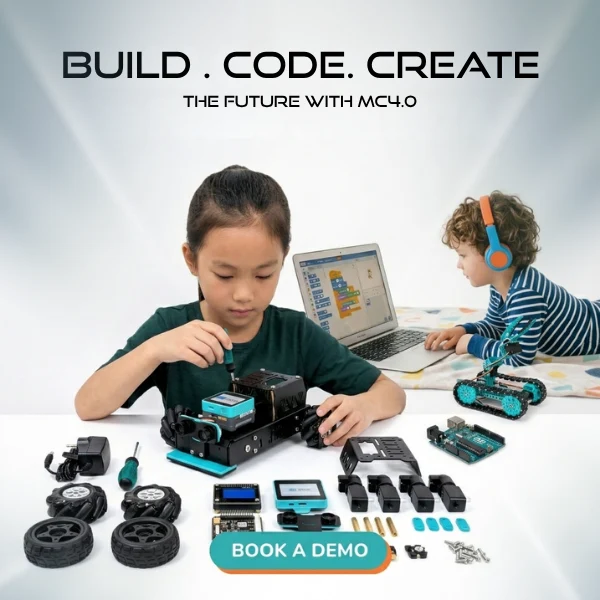
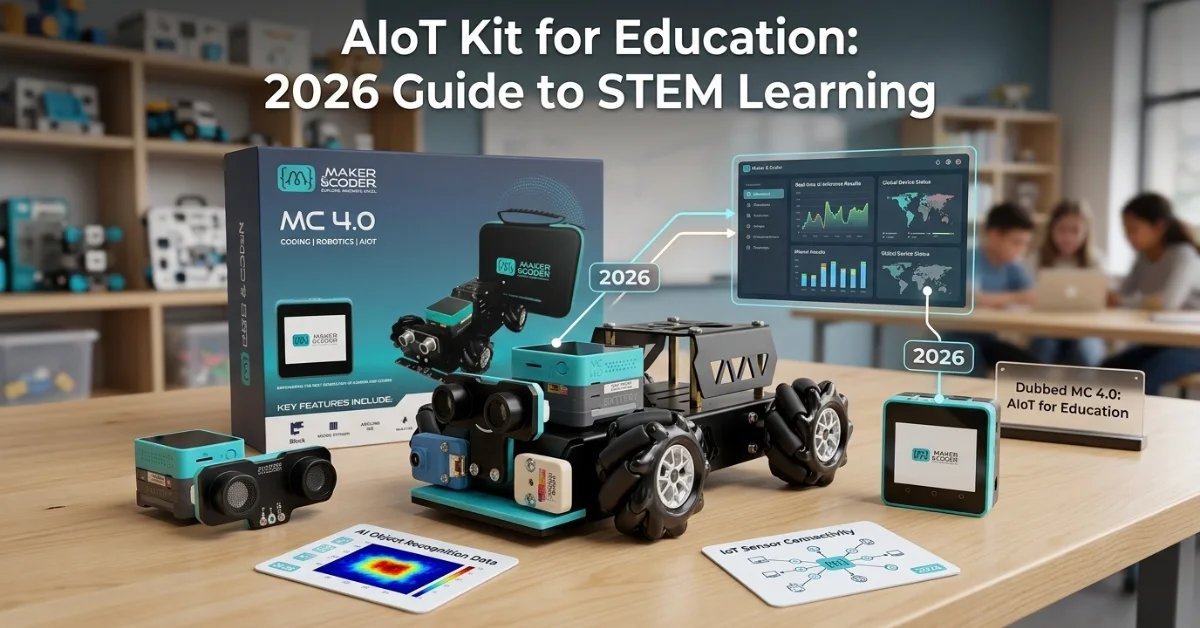
What if your students stopped simply following scripts and started building systems that actually think? In the rapidly evolving landscape of 2026, the traditional approach to STEM often feels disconnected from the industrial reality of connected intelligence. You’ve likely seen the struggle: students master basic logic on a screen, yet they lack the tools to apply those skills to the physical world. Choosing the right AIoT kit for education is no longer just about buying hardware. It’s about investing in a gateway to professional-grade engineering that empowers the next generation of innovators.
We understand the frustration of fragile components that break during the first lesson and the lack of structured pathways to guide your instruction. This guide helps you move beyond siloed learning to create a seamless journey from block-based coding to advanced Python applications. You’ll discover how to transform your STEM lab into a hub of innovation where students build tangible projects that demonstrate real AI decision-making. We will walk through the essential components of a future-proof ecosystem that ensures your students are ready for the challenges of a connected world.
Key Takeaways
- Master the “Sense-Think-Act” loop to bridge the gap between physical sensors and intelligent decision-making in your classroom.
- Identify the essential features of a professional-grade AIoT kit for education, focusing on the synergy between the MC4.0 Controller and modular MC Blocks.
- Evaluate STEM lab investments using a 2026 framework that prioritizes hardware durability and seamless software scalability from Scratch to Python.
- Implement a structured K-12 MC Curriculum that transforms students from passive technology consumers into innovative problem solvers.
- Shift from siloed coding exercises to integrated, project-based learning that mirrors real-world industrial applications and technical standards.
What is an AIoT Kit for Education and Why Does it Matter Now?
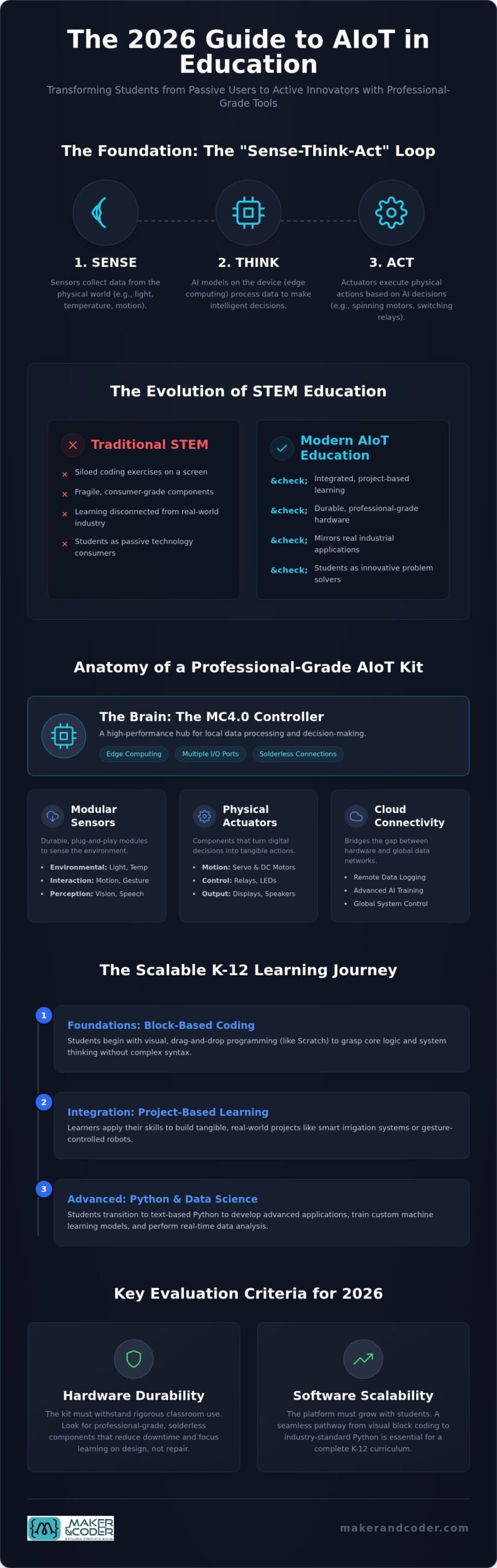
The world has moved beyond simple circuits and isolated code. Today, innovation happens at the intersection of connectivity and intelligence. An Artificial Intelligence of Things (AIoT) kit for education represents this shift, combining the data-gathering power of the Internet of Things (IoT) with the decision-making capabilities of Artificial Intelligence (AI). In 2026, teaching these as separate subjects is no longer sufficient. Students need to understand the “Sense-Think-Act” loop: sensors collect environmental data (Sense), AI models process that information to make a choice (Think), and mechanical components execute a physical response (Act). This feedback loop is the backbone of autonomous vehicles, smart cities, and modern industrial automation.
The Evolution from STEM to AIoT Literacy
STEM education has undergone a profound transformation. We’ve moved from basic breadboards to cloud-connected ecosystems where data is the primary currency. Selecting a professional AIoT kit for education requires a move away from fragile, consumer-grade gadgets toward professional hardware that mirrors industry standards. This transition ensures that students aren’t just playing; they’re practicing. Data literacy is now a core requirement for the modern workforce. By working with physical computing, students turn abstract machine learning concepts into tangible results they can touch and see. They learn that AI isn’t a mysterious “black box” but a tool shaped by the data they provide.
Bridging the Gap Between Software and the Physical World
The physical world is messy and unpredictable. IoT sensors act as the “eyes and ears” for AI models, providing the raw input needed to navigate this complexity. When a student builds a smart irrigation system or a gesture-controlled robot, they’re managing real-time data processing. This is where the true learning happens. We’re moving students from being passive “users” of proprietary apps to becoming “creators” of their own intelligent systems. By using professional-grade components like the MC4.0 Controller, learners gain the confidence to design solutions that solve actual community problems. It’s about shifting the focus from “how does this code run?” to “how does this system interact with its environment?”
Core Components of a Professional-Grade AIoT Kit
A professional AIoT kit for education is more than a box of sensors. It’s a cohesive ecosystem designed to survive the rigors of a K-12 environment while delivering industrial-grade performance. To build a system that truly “thinks,” students need hardware that mimics the complexity of the real world. This starts with a centralized processing hub and extends to a modular set of inputs and outputs that can be reconfigured for any challenge.
The MC4.0 Controller: A High-Performance Hub
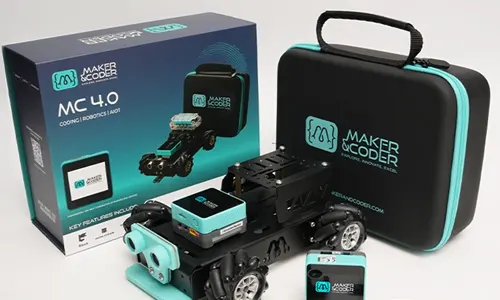
The MC4.0 Controller acts as the central brain of the entire platform. In the context of AIoT, processing power is critical because many AI models require edge computing. This means the device analyzes data locally rather than waiting for a response from a distant server. By providing multiple input and output ports, the MC4.0 Controller allows for the simultaneous management of complex data streams. It integrates perfectly with MC Blocks, enabling students to snap components together without fragile wiring or the need for soldering. This solderless approach ensures that the focus remains on logic and system design rather than troubleshooting loose connections.
Modular Sensors and Actuators
Reliability is paramount in a classroom setting. Modular MC Blocks reduce downtime by providing durable, plug-and-play connections that stand up to repeated use. For an AIoT kit for education to be effective, it must include a diverse range of sensors categorized by their function. Environmental sensors track the world around the device, measuring variables like light and temperature. Biometric and motion sensors allow for human interaction, while vision sensors and speech recognition modules allow the AI to “see” and “hear” its surroundings. Actuators then take the processed information and turn it into physical action. Whether it’s a motor spinning or a relay switching, these components demonstrate the tangible impact of AI decision-making.
True AIoT projects aren’t restricted to a single desk. They require cloud connectivity for remote data logging and advanced AI training. This allows students to upload their sensor data to the web, creating a bridge between their physical hardware and global data networks. It’s this connectivity that transforms a simple robot into a smart, connected device capable of participating in the wider digital world. If you are ready to bring these capabilities to your STEM lab, you can reach out to our team to discuss your specific classroom needs.
How to Evaluate AIoT Kits: A 2026 Comparison Framework
Choosing an AIoT kit for education requires a shift in perspective. You aren’t just purchasing hardware; you’re investing in a long-term pedagogical ecosystem. In 2026, the market is flooded with options ranging from basic ESP32 starter kits to sophisticated edge-computing platforms. To make a future-proof investment, educators must evaluate tools based on three critical pillars: durability, scalability, and software compatibility. A kit that works in a controlled lab might fail in a standard classroom. Look for hardware designed for technical learning rather than mere play. This distinction ensures your STEM lab remains operational year after year.
The debate between “open” and “closed” ecosystems is more relevant than ever. Closed systems might offer a polished initial experience, but they often restrict students to proprietary software. Open ecosystems allow for integration with industry-standard cloud platforms and third-party AI models. This flexibility is vital for preparing students for real-world engineering. Don’t overlook the hidden costs of kits that lack structured support. A cheap set of components without a comprehensive curriculum or teacher training often ends up gathering dust. True value lies in the support systems that empower teachers to lead with confidence.
Scalability: From MC4.0 Base Kit to AIoT Mastery
Effective STEM programs grow with the student. The MC4.0 Base Kit serves as the ideal entry point, introducing fundamental concepts of logic and electronics. As learners progress, the MC4.0 AIoT Kit adds layers of complexity without requiring a complete hardware overhaul. This unified platform approach across different grade levels reduces the learning curve for both students and teachers. By using a consistent controller and modular MC Blocks, schools can scale their investment from simple automation to advanced machine learning projects. It’s a methodical journey that builds confidence at every step.
Software Versatility: Python and Beyond
Software is the bridge between a sensor’s data and an AI’s decision. A professional-grade kit must support a seamless transition from visual, block-based programming to text-based code like Python. This shift is essential for high school students aiming for technical careers. Research indicates that seamless cloud integration can cut IoT development timelines by 30-40%, allowing students to focus on solving problems rather than troubleshooting connectivity. High-quality kits integrate directly with professional cloud services, enabling students to log data remotely and train AI models on real-world datasets. This level of versatility ensures your classroom technology remains relevant as industry standards evolve.
Implementing AIoT in the Classroom: From Curriculum to Competition
Implementation transforms a collection of parts into a powerful learning experience. Success in the classroom depends on a structured approach that balances technical rigour with creative freedom. By adopting an AIoT kit for education, schools can move from isolated coding exercises to integrated project-based learning (PBL) that addresses real-world issues. Imagine students designing a smart carbon-monitoring system for their campus or an automated hydroponic garden. These projects require students to apply the “Sense-Think-Act” loop discussed earlier, ensuring they understand the practical utility of every line of code.
Engagement often peaks when students see a clear goal. Competition kits provide this focus, pushing learners to refine their designs and optimize their AI models. This competitive edge drives mastery. It encourages students to iterate on their builds using the modular MC Blocks, turning failure into a necessary step toward innovation. When students compete, they aren’t just building robots; they’re demonstrating their ability to manage complex, autonomous systems.
The K-12 MC Curriculum: A Structured Pathway
Pedagogical progression is the heart of the MC 4.0 ecosystem. The K-12 MC Curriculum provides a clear roadmap that aligns with international STEM standards, ensuring that every project contributes to long-term cognitive development. Teachers can utilize the MC4.0 STEAM Kit to plan lessons that cater to varying skill levels, moving students from primary logic to secondary data science. Assessment becomes more meaningful when it focuses on system design rather than just syntax. You aren’t just grading a program; you’re evaluating a student’s ability to manage a connected environment.
Professional Development: Empowering the Educator
Technology moves fast, and teachers shouldn’t have to catch up alone. Most guides treat hardware as the only solution, but we view Teacher Training Programs as a core pillar of successful implementation. These programs are designed to reduce tech-anxiety by providing hands-on experience with the MC4.0 AIoT Kit before it ever reaches the students. By building a community of practice, educators can share resources and troubleshoot advanced implementations together. This ongoing support ensures that your investment in a STEM lab remains a vibrant part of the school culture. If you’re ready to modernize your school’s curriculum, contact our educational consultants today to start your journey.
The Maker & Coder Advantage: The MC4.0 AIoT Ecosystem
Maker & Coder operates as an “expert-as-enabler,” ensuring that complex modern systems become accessible tools for creative expression. We don’t just provide parts; we provide a complete modular ecosystem. The MC 4.0 platform is designed to be the ultimate AIoT kit for education in 2026, offering a level of sophistication that matches academic standards while remaining approachable for primary and secondary learners. By bridging the gap between high-level engineering and classroom instruction, we help schools build a foundation for lifelong technical mastery.
Our vision is rooted in the belief that students deserve hardware that reflects the professional world they will one day enter. This is why the MC 4.0 platform avoids the aesthetic of simple toys, opting instead for a “prestige-tech” feel that emphasizes quality, advancement, and reliability. When students hold an MC4.0 Controller or snap together modular MC Blocks, they feel the weight of professional-grade equipment. This tactile experience shifts their mindset from passive consumption to active, purposeful innovation.
The MC4.0 AIoT Kit: Purpose-Built for Innovation
This isn’t just another classroom set. The MC4.0 AIoT Kit delivers a professional experience, combining industrial-grade durability with an intuitive, solderless design. Students who work with our hardware aren’t just learning to code; they’re learning to manage high-performance systems. Case studies from our global partners show that when students use professional tools, their engagement levels rise. They stop seeing technology as a challenge to be overcome and start seeing it as a medium for solving actual problems. You can explore the full technical specifications and browse our collection at the Maker & Coder Shop.
Your Partner in STEM Excellence
Our commitment to your success goes beyond the initial purchase. We act as a dedicated educational partner, offering a structured K-12 MC Curriculum and specialized Teacher Training Programs to ensure every school can achieve STEM excellence. We empower you to transition from basic logic to advanced AI applications with confidence. Whether you’re looking to upgrade a single classroom or implement a school-wide STEM lab investment, we invite you to start your AIoT journey today. Reach out for a consultation to see how our modular blocks and visionary curriculum can transform your educational environment and prepare your students for the future.
Empower the Next Generation of Innovators
The journey from basic STEM concepts to connected intelligence requires a shift in both tools and mindset. You’ve seen how the “Sense-Think-Act” loop defines modern systems and why professional-grade hardware is essential for long-term classroom durability. By integrating modular MC Blocks and a structured pedagogical path, you move students beyond simple coding and into the realm of complex system design. This approach ensures they’re ready for the industrial realities of 2026.
Selecting the right AIoT kit for education is a strategic investment in your students’ future-readiness. Our ecosystem provides a comprehensive foundation for success, featuring a structured K-12 curriculum and professional teacher training programs that empower educators to lead with authority. It’s time to bridge the gap between abstract software and the physical world with a platform built for technical excellence.
Ready to transform your STEM lab into a hub of innovation? Explore our professional AIoT kits and K-12 curriculum to start your journey today. The future of technical education is tangible, connected, and entirely within your reach.
Frequently Asked Questions
What age group is the MC4.0 AIoT Kit designed for?
The MC4.0 AIoT Kit is engineered for the entire K-12 spectrum, offering scalability that grows with the student. Primary learners begin with visual logic while secondary students tackle complex data science and machine learning. This flexibility makes it a versatile AIoT kit for education that fits diverse grade levels. By using a unified hardware platform, schools ensure a consistent learning journey from basic automation to advanced autonomous system design.
Do I need prior AI knowledge to teach with an AIoT kit?
You don’t need extensive technical expertise to lead an AIoT classroom effectively. Our Teacher Training Programs are designed to empower educators of all backgrounds by providing hands-on experience and clear pedagogical strategies. We act as an “expert-as-enabler,” giving you the tools and confidence to guide your students through complex projects. The structured K-12 MC Curriculum removes the guesswork, allowing you to focus on facilitating discovery rather than troubleshooting code.
Does the MC 4.0 platform support Python programming?
Yes, the MC 4.0 platform provides full support for Python programming to prepare students for professional environments. Learners typically start with block-based coding to master fundamental logic before transitioning to text-based Python for more advanced AIoT applications. This progression ensures they develop industry-standard skills. The MC4.0 Controller handles the processing power required for these high-level languages, making it a robust choice for secondary education and pre-professional technical training.
What is the difference between the MC4.0 Base Kit and the AIoT Kit?
The MC4.0 Base Kit focuses on foundational electronics and logic, while the AIoT Kit introduces advanced sensors and connectivity for intelligent systems. Think of the Base Kit as the entry point for understanding circuits and simple automation. The AIoT Kit expands these capabilities with components like vision sensors and cloud integration. This modular approach allows schools to start with the essentials and scale their STEM lab investment as students’ technical skills mature.
How does the MC Curriculum align with standard school requirements?
The MC Curriculum is meticulously aligned with international STEM standards to ensure every lesson contributes to recognized academic goals. It moves beyond simple coding by focusing on system-wide thinking and data literacy, which are core requirements for the 21st-century workforce. Each unit is designed for pedagogical progression, making it easy to track student growth in complex system design. This structured path provides peace of mind for administrators looking to meet rigorous educational benchmarks.
Are the MC Blocks compatible with other STEM hardware?
MC Blocks are designed as a dedicated, modular ecosystem that integrates seamlessly with the MC4.0 Controller. This solderless system prioritizes durability and rapid prototyping, ensuring components stay secure during intense classroom use. While they are optimized for the Maker & Coder hardware environment, their modular nature encourages creative expansion. They provide a professional feel that stands out from standard consumer kits, offering a reliable foundation for high-level student projects and technical experimentation.
What kind of teacher training is provided with the kits?
We offer professional Teacher Training Programs that provide a comprehensive roadmap for successful classroom implementation. These sessions focus on hands-on hardware mastery and curriculum integration, specifically designed to reduce tech-anxiety among staff. Educators join a global community of practice, gaining access to ongoing support and resources for advanced AIoT implementations. This training ensures that your investment in an AIoT kit for education translates into measurable student success and long-term teacher confidence.
Can I use AIoT kits for competitive robotics?
Absolutely, the MC 4.0 platform is ideal for competitive robotics and project-based challenges. The modularity of MC Blocks allows students to iterate quickly on their designs, which is a critical advantage in a competition setting. Using the high-performance MC4.0 Controller, teams can build autonomous systems that demonstrate real-time AI decision-making. These kits drive engagement by giving students a tangible goal, pushing them to optimize their code and hardware for peak performance in any arena.